
FYI: I share links in this post to products I actually recommend. If you purchase through my affiliate link, I receive a small commission at no extra cost to you.
KEEP READING FOR MY FREE CLASSROOM DECLUTTER DECISION TREE
Three years ago, I was fed up.
I found a pile of broken pencils. Again.
Apparently, Christian (not his real name) had discovered a new talent: breaking them with his head.
There were at least 20 markers on the floor. No caps. Just slowly drying out like they had given up on life.
Our novel study books? Absolute chaos. Bent, missing, shoved into a pile near the shelf like crumpled receipts.
And I remember standing there thinking Why does everything feel so out of control all the time?
Because it wasn’t just the supplies.
I had technically done everything right. I had a teacher space, a student supply hub, a designated spot for turn in bins and no name trays. But it was still too much. Then one day it hit me. I had worked to make my home minimalist. My classroom needed the same minimalist overhaul. What I currently had was too much.
Too many supplies.
Too many systems.
Too many “just in case” things I never actually used.
And somehow, I was still constantly:
- cleaning
- losing things
- reorganizing
- restocking
- and feeling behind
So I stopped trying to organize it. Instead, I purged it. Aggressively.
Piles by the dumpster. Mass emails with photos of supplies sent to the whole school: “free to a good or mediocre home—unclaimed items discarded at 5pm.”
I Got Rid of the Extra (Minimalist Classroom Basics)
Not “label more bins.”
Not “buy a better system.”
Get rid of it.
All the “just in case” supplies? Gone.
Random leftovers from old units? Gone.
That cart full of stuff I hadn’t touched in months? Gone. (Yes, the carts. They look helpful. They are not. They are infuriating.)
And here’s the part no one tells you:
You won’t miss any of it.
I Stopped Hoarding Supplies (and Built an Actual System Instead)
I used to have that cabinet. You know the one.
Stuffed with:
- random markers
- half-used notebooks
- leftover supplies from three years ago
- things I was saving “just in case”
- hand-me-downs from the teachers before me
Despite my best efforts, it wasn’t organized. It was a graveyard.
So I cleaned it out. Ruthlessly.
It wasn’t easy. I hemmed and hawed. Debated. Agonized. Ultimately, I made a decision tree to help. It was oddly effective.
Click Here for the FREE ONE PAGE SHOULD I KEEP THIS DECISION TREE
And instead of refilling it with more resources junk, I turned it into my supply control center.
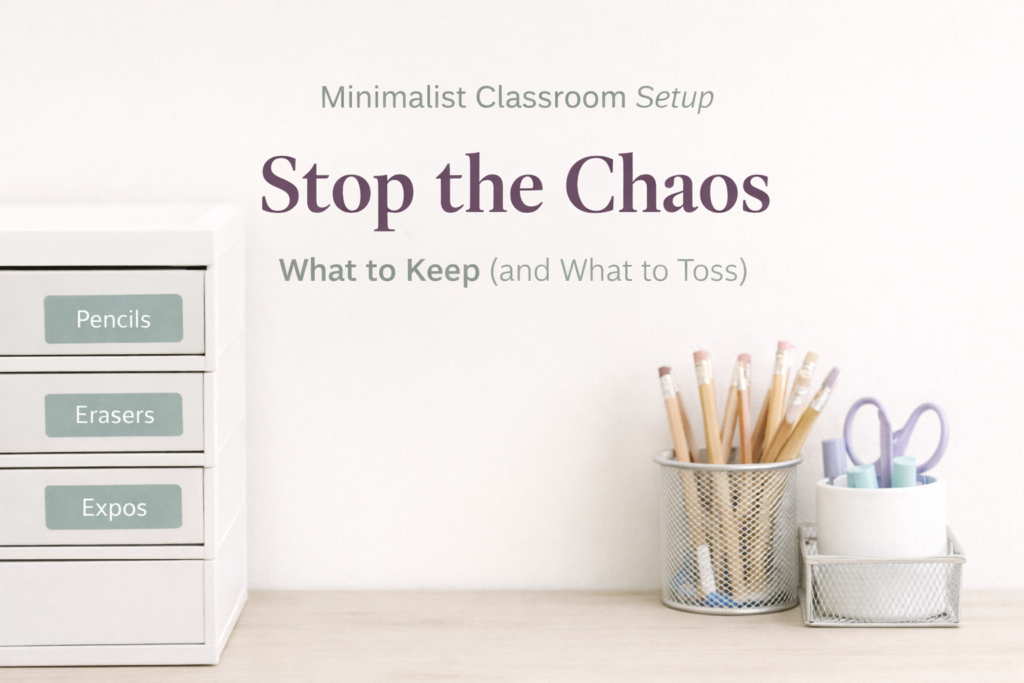
Everything we actually used went in there. I used labeled stackable cases in very specific categories. Not supplies or miscellaneous. Gluesticks. Pencils. Erasers. Expos. Easy to grab out exactly what I needed without a lot of shuffling.
I grouped them by type. The top shelf was my unit plans (also organized in grab and go containers). The second shelf (the eye level one) was for supplies students or I might need regularly. The third shelf was my copy paper, construction paper, cardstock etc. At the bottom was my backstock of tissues, hand sanitizer, wipes and paper towels.
Here’s the potentially controversial part. I locked it. The whole cabinet was lockable.
The kids all knew the supplies were there. So did my coworkers. Need a supply? No problem. Let me grab my key.
Not hoarded. Just controlled.
I Put Out Less (On Purpose)
This was the shift that changed everything.
I didn’t stock tables with endless supplies anymore.
I put out:
- 5 pencils at a time
- what we needed for that lesson
- nothing extra
That’s it.
If a student needed something I didn’t have out? They asked.
People get weird about this, but let’s be honest:
When everything is unlimited and always available, it gets treated like trash.
When access is controlled, it gets treated like it matters.
Drawers > Chaos (Classroom Organization That Actually Works)
My teacher desk area was not immune from the purge. Arguably, it was the area I was the most ruthless in. Open bins and cute setups look great for about five minutes.
After that? Disaster.
Drawers saved me.
Everything had a place.
Everything was contained.
Nothing was spilling, stacking, or “temporarily sitting here.”
If it didn’t fit in a drawer or a designated space, I didn’t need it.
I didn’t use a fancy drawer system. I used the teacher desk that came with the classroom and a very dented filing cabinet someone was getting rid of over the summer.
I Stopped Decorating for the Sake of It
This might be controversial, but most classroom decor is for adults, not kids.
And more importantly—it was adding to the chaos.
When every wall is covered, nothing stands out. Students stop looking. Your brain stops processing. It becomes visual noise.
Instead of covering my walls in stuff, I rotated anchor charts with each unit and displayed student work that matched what we were actually learning. I stored my off season ones away until we actually needed them in an anchor chart storage bag.
So what was on the wall actually mattered.
No visual clutter.
No overstimulation.
No ignoring everything because there’s too much to look at.
I’ll be honest. I was afraidd the kids were going to absolutely hate it. The biggest feedback I actually got from students?
“It feels calm in here.”
I’ll take calm over cute every time.
What Actually Changed?
Not the aesthetic.
The function.
I stopped spending my entire planning period cleaning
- I could find what I needed immediately, even mid class chaos
- My systems actually worked
- Students respected materials more
- I wasn’t constantly overwhelmed by my own classroom
And the weirdest part?
I didn’t miss a single thing I got rid of.
Not one.
If You’re Overwhelmed, Start Here
Don’t redo your whole classroom.
Just pick one small section. Start with the one you have to reorganize the most. Look at the actual items in that space and ask yourself:
Do I actually use this, or am I just scared to get rid of it?
Because those are not the same thing.
And if you’re honest?
You already know the answer.