

I taught for 12 years.
There’s a version of teaching people love to talk about.
The inspiring moments. The connections. The “you’re making a difference” speeches.
And look—those things are real.
But they are not the whole story.
Here’s the part no one really says out loud—and what you can actually do about it.
1. You will never feel caught up
There is always something else.
Grading. Emails. Planning. Data. Meetings.
You can finish 10 things and immediately have 15 more.
If you’re waiting to feel “done” before you relax, you won’t. Ever.
What actually helps:
Pick a daily “done list” (3–5 non-negotiables) and stop when those are finished. Everything else is optional, even if the system pretends it isn’t.
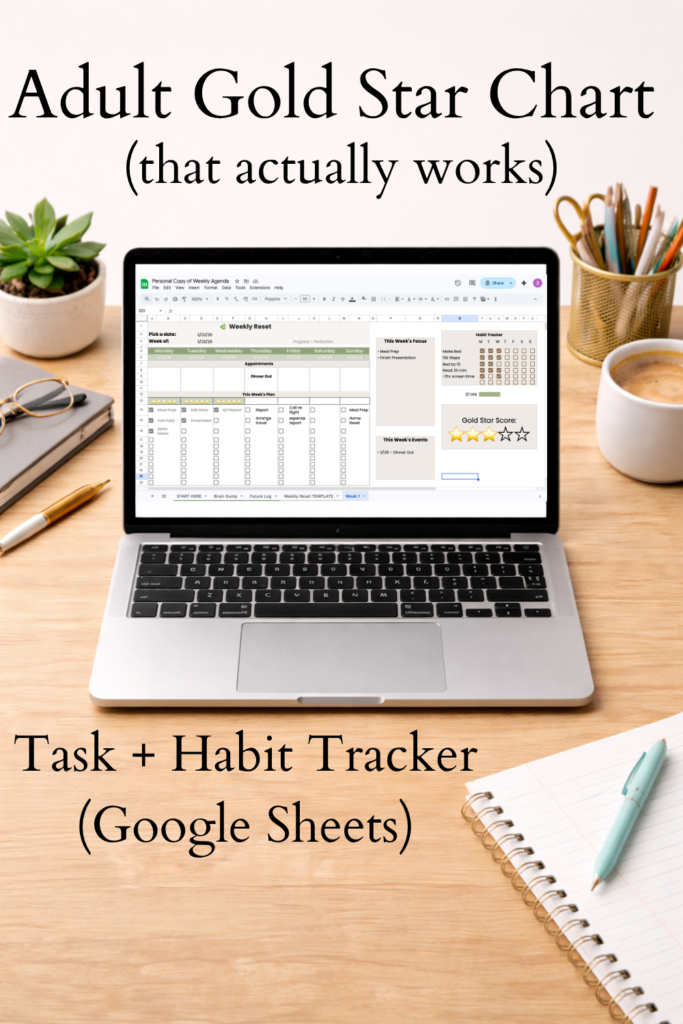
Need an added dose of motivation? Check out my adult gold star tracker on Etsy.
2. The emotional labor is worse than the workload
The work itself? Manageable. Systems exist for a reason.
The constant need to be “on”? Exhausting.
You’re not just teaching content.
You’re managing behavior, emotions, conflict, trauma, and expectations—all at the same time.
No college class prepares you for 5 trauma dumps before 9am.
What actually helps:
Have 2–3 default responses ready (“I hear you, let’s come back to this after class” / “I want to help, but I need a minute”) so you’re not emotionally improvising all day.
3. You will care more than is sustainable
No one tells you how hard it is to turn it off.
You think about your students at night.
You worry about them on weekends.
And at some point, that level of care starts costing you more than it should.
What actually helps:
Set a hard “cutoff ritual” (close laptop, change clothes, leave the room). If you don’t mark the end of the day, your brain won’t either.
4. “Self-care” will be suggested instead of actual support
You’ll be told to take care of yourself. Remember your why.
Usually right before or after being given more to do.
You can’t bubble-bath your way out of systemic issues.
What actually helps:
Reduce inputs, not just add coping. Say no to one extra thing a week. That matters more than any “self-care” routine.
5. You will question yourself constantly
Am I doing enough?
Am I doing this right?
Should I have handled that differently?
Is Johnny’s mom going to send me a stinging email? Is she right about me?
Even when you’re good at your job, the doubt doesn’t fully go away.
What actually helps:
Pick 1–2 metrics that actually matter to you (student understanding, classroom flow) and ignore the rest. Otherwise, everything feels like failure.
6. The system will expect more than is realistic
More differentiation.
More data.
More engagement.
More everything.
With the same amount of time.
What actually helps:
Reuse and recycle everything. Good lessons don’t need to be reinvented. Survival teaching is still effective teaching.
7. The “good days” can keep you stuck
You’ll have days where everything clicks.
Students are engaged. Lessons go well. You leave feeling like, “Okay… this is why I do this.”
And those days are just enough to make you stay longer than you probably should.
What actually helps: Zoom out. Don’t evaluate your career based on your best day or your worst. Look at your average week.
8. Boundaries are not optional
If you don’t set them, the job will take everything you give it.
And then ask for more.
And when you burn out, the system keeps moving without you.
What actually helps: Stop answering emails after a set time. Even once. You’ll realize nothing actually explodes. And if email is on your phone, take it off now.
9. You can’t fix the system
The education system is broken.
You’re not going to fix it on your own—and trying to carry that responsibility will break you.
Your first priority should be you.
Your health, your sanity, your happiness.
If it isn’t that, it’s time to reevaluate.
What actually helps:
Focus on your classroom, not the entire system. That’s the only place you actually have control.
10. You’re not the only one feeling this way
Even if no one around you is saying it.
Even if everyone else looks like they have it together.
They don’t.
A lot of people are just really good at hiding it.
What actually helps:
Find one honest person. Not the toxic positivity one. The real one. That alone can change how heavy this feels.
If you’re in it right now and feeling this… you’re not dramatic. You’re not weak.
You’re responding to something that is actually hard.
And if you’re trying to figure out how to make it work—or what comes next—you’re not the only one doing that either.
I’ll be sharing what actually helped me function in the classroom—and what I’m building now outside of it.
Because surviving shouldn’t be the goal.